
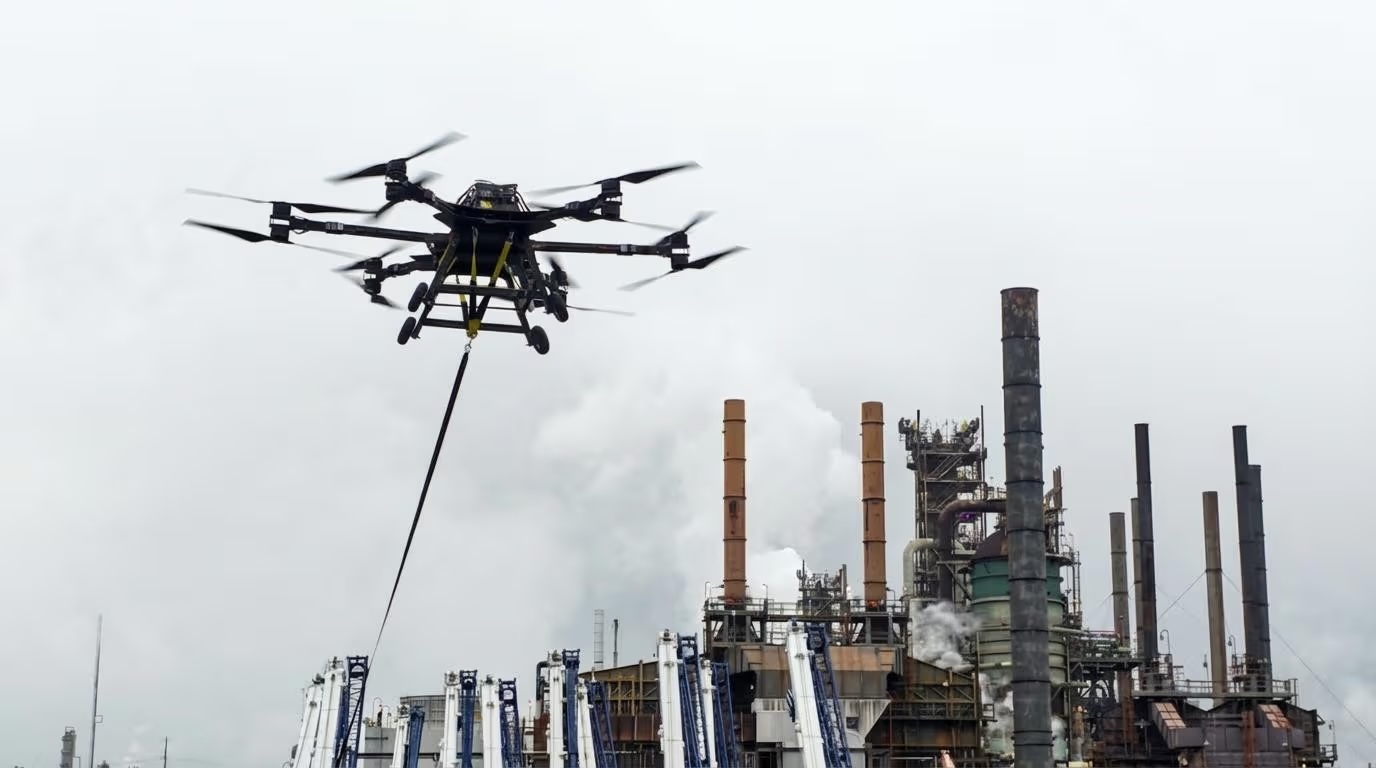
The Future of Heavy-Lift Drones in Military Logistics
A practical look at how heavy-lift UAVs support modern military logistics and distributed operations.
Introduction
Military logistics has always depended on reliable transportation across difficult terrain and under uncertain conditions. In recent years, heavy-lift unmanned aerial vehicles (UAVs) have emerged as a complementary tool for resupply, surveillance support, and distributed operations.
While heavy-lift drones are not a replacement for helicopters, fixed-wing aircraft, or ground vehicles, they offer distinct advantages in specific use cases — particularly where access is constrained, risk is elevated, or speed is critical. As defense organizations continue to evaluate autonomous systems, heavy-lift UAVs are increasingly part of the broader logistics conversation.
What Are Heavy-Lift Drones?
Heavy-lift drones are UAV platforms designed to carry larger payloads than small tactical drones. Depending on configuration and mission profile, they may transport equipment, supplies, sensors, or communication systems over short-to-medium distances.
Typical characteristics include:
-
Vertical takeoff and landing (VTOL) capability
-
Modular payload configurations
-
Autonomous or semi-autonomous navigation
-
Operation without onboard crew
Payload capacity, range, and endurance vary widely across platforms, and performance depends heavily on environmental conditions and mission requirements.
Where Heavy-Lift UAVs Fit in Military Logistics
Heavy-lift drones are most effective when used alongside existing logistics infrastructure rather than in place of it. Several operational scenarios illustrate their value.
Last-Mile Resupply
One of the most frequently discussed applications is last-mile resupply. In contested or geographically complex environments, transporting supplies by road can be slow or risky. UAVs can help deliver small but essential loads — such as medical supplies, batteries, or repair components — directly to forward positions.
Distributed Operations Support
Modern military planning increasingly emphasizes distributed operations across dispersed units. UAVs can support this model by enabling smaller, decentralized resupply deliveries without requiring large logistics movements.
ISR and Sensor Deployment
Heavy-lift UAVs are also used to transport ISR payloads, communications equipment, or temporary infrastructure. In some scenarios, they can help rapidly position sensors where fixed installations are not practical.
Contested or High-Risk Environments
In environments where crewed aircraft face elevated risk, unmanned systems offer an alternative approach for certain mission profiles. Their use depends on airspace conditions, threat levels, and mission constraints.
Advantages of Heavy-Lift UAV Systems
Heavy-lift drones provide several operational advantages in defined use cases.
Flexibility
Because they do not require runways and often operate with smaller crews, UAVs can deploy from relatively austere locations.
Speed of Deployment
In certain scenarios, UAVs can reduce response times compared with ground transport, particularly across difficult terrain.
Reduced Personnel Exposure
Unmanned systems may reduce exposure for logistics personnel in higher-risk environments, though they introduce different operational considerations.
Modularity
Many heavy-lift UAV platforms are designed with modular payload bays that allow operators to adapt them for different missions.
Limitations and Operational Considerations
Despite growing interest, heavy-lift UAVs have clear limitations.
Payload Constraints
Even the largest UAV platforms typically carry less weight than helicopters or ground vehicles. They are best suited to targeted deliveries rather than bulk transport.
Weather Sensitivity
Wind, precipitation, and temperature conditions can significantly affect UAV performance and mission feasibility.
Airspace Integration
Operating UAVs safely alongside crewed aircraft requires robust coordination and regulatory alignment.
Cost and Sustainment
Lifecycle cost considerations include maintenance, training, and infrastructure requirements in addition to procurement.
For these reasons, heavy-lift drones are generally viewed as one component of a broader logistics strategy.
How Defense Organizations Are Evaluating UAV Logistics
Defense organizations worldwide are studying UAV logistics through pilot programs, exercises, and operational testing. These evaluations often focus on:
-
Reliability across mission environments
-
Integration with existing command and control systems
-
Operational readiness and maintainability
-
Interoperability with other platforms
Findings from these programs continue to shape procurement strategies and operational doctrine.
The Role of Autonomy in Logistics Operations
Autonomy is a major area of development across defense logistics. Advances in navigation, sensing, and mission planning software are improving UAV capability, though human oversight remains central in most operations.
Current development efforts often emphasize:
-
Assisted navigation in GPS-challenged environments
-
Obstacle detection and avoidance
-
Mission planning optimization
-
Fleet coordination
The pace of adoption will likely depend on technical maturity, regulatory frameworks, and operational experience.
Looking Ahead
Heavy-lift drones are unlikely to replace traditional logistics platforms. However, their ability to support targeted resupply, distributed operations, and flexible deployments suggests they will remain relevant as defense logistics evolves.
As with any emerging technology, long-term adoption will depend on demonstrated reliability, cost effectiveness, and operational alignment with mission requirements.
Conclusion
Heavy-lift UAVs represent a practical addition to the military logistics toolkit. While not suitable for every scenario, they provide useful capabilities in environments where traditional options are limited.
As defense organizations continue evaluating autonomous systems, heavy-lift drones will likely play a defined — and carefully integrated — role in future logistics operations.