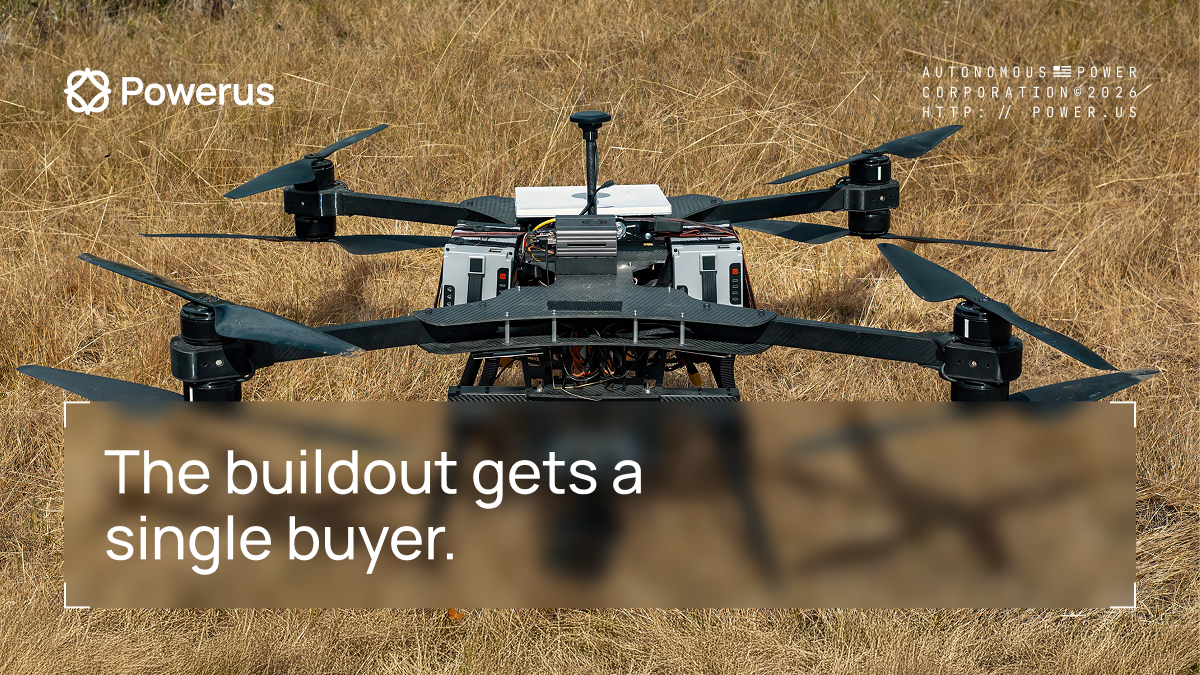
The S-4 Is In
Aureus Greenway has filed the Form S-4 registration statement for its proposed business combination with Powerus; it has not yet become effective. Also this week: US spray drones covered 16.4 million acres in 2025, up 58.7 percent, on 58.5 percent fewer new aircraft sold.

Powerus Signal · Week of July 27, 2026

The Filing
The proposed combination moved from announcement to paperwork this week, and the paperwork is the part that starts the clock.
Aureus Greenway Holdings Inc. (Nasdaq: PUSA) and Powerus jointly announced this week that AGH has filed a Form S-4 registration statement with the US Securities and Exchange Commission in connection with the proposed business combination between the two companies, first announced in March. The registration statement has not yet become effective, and the securities described in it may not be sold, nor may offers to buy be accepted, before it becomes effective.
If you have not watched a company head toward public markets through a combination before, here is the sequence behind that careful sentence. The S-4 is the document that lays the transaction out in full, including an information statement and a preliminary prospectus. The SEC reviews it and can comment and require amendments. Only after it is declared effective does AGH mail the definitive information statement to its stockholders. The merger stays subject to customary closing conditions throughout, including that effectiveness and applicable regulatory approvals. Filing is how the process starts, not how it ends.
One move already sits on the tape ahead of all of that: AGH changed its Nasdaq ticker to PUSA in anticipation of the pending combination.On completion the combined company is expected to operate as Powerus Corporation and continue to trade under that symbol.
The filing also caps a run of operational news Powerus announced through the spring: a $30 million strategic equity investment by Unusual Machines, an order of more than $5 million with Unusual Machines for US-made components, and a memorandum of understanding with Swarmer on autonomous swarming integration.
“Filing the Form S-4 moves this combination from agreement to execution. Every step in this process is about giving Powerus the platform to scale what we’ve already built, and we’re treating each regulatory milestone with the discipline our shareholders and the market expect.”
Andrew Fox, CEO of Powerus
Additional information about the proposed transaction is set forth in the registration statement and related materials filed with the SEC. Investors and security holders are urged to read those materials when they become available. Free copies are available through the SEC’s website and at AGH’s filings page.
This section reports a company announcement. The full offer disclaimer and forward-looking statements notice for the proposed transaction appear at the end of this issue.
This Week’s Briefing: Sixteen Million Acres, Fewer Aircraft
US spray drone acreage grew 58.7 percent in 2025 while new spray aircraft sales fell 58.5 percent, per the American Spray Drone Coalition’s 2025 industry survey.
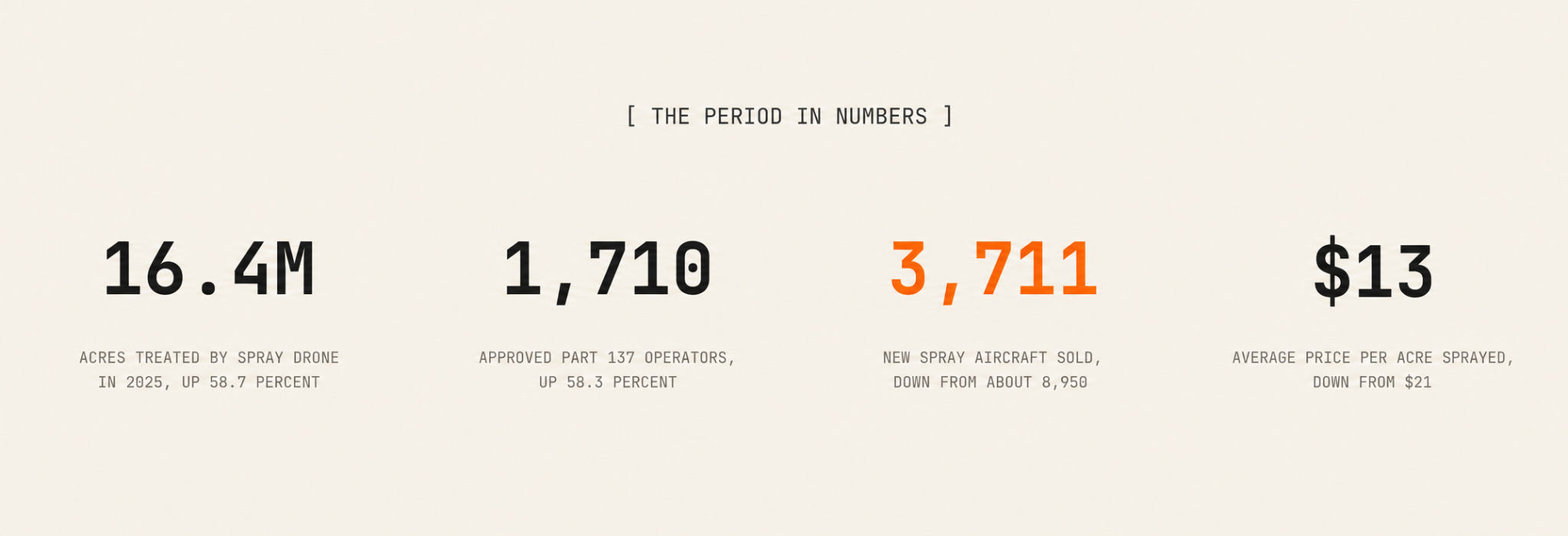
Sources: acres treated and operator count (American Spray Drone Coalition, 2025 industry survey); new aircraft sold and price per acre (same survey, market data section).
An industry that treats 58.7 percent more ground while buying 58.5 percent fewer aircraft is not scaling. It is absorbing a shortage. The distinction decides who wins the next five years of agricultural autonomy.
Both figures from the American Spray Drone Coalition’s 2025 industry survey: treated acreage up 58.7 percent year over year, new spray aircraft sales down 58.5 percent, from about 8,950 units to about 3,711.
American agricultural drones covered more than 16 million acres in 2025. That is the largest year the category has recorded, and almost none of it came from aircraft getting better.
It came from more people flying. The certifiied operator base grew by nearly the same percentage as the acreage, and the average operator treated no more ground than the year before. Meanwhile sales of new spray aircraft fell by more than half.
Underneath those three numbers sits a market reshaped by supply rather than by preference. American-made aircraft nearly quadrupled their share of a market that was shrinking, and the operators buying them rank origin near the bottom of what drives their purchase. A heavy-lift manufacturer walked into that market on July 23.
The Acreage Grew. The Fleet Did Not.
Growth came from participation, not from productivity.
The American Spray Drone Coalition surveys the certifiied side of this market every year and applies its sample to the operator population the FAA reports. Its 2025 industry survey puts total treated acreage above 16.4 million acres, up 58.7 percent year over year.
Two figures explain almost all of that. The number of approved Part 137 operators rose 58.3 percent to 1,710. The average acres treated per operator came in at 9,584 and was statistically flat.
So the category added roughly six million acres by adding roughly six hundred operators. The aircraft themselves, including the higher-capacity models that reached the market during the period, did not measurably move the per-operator number.
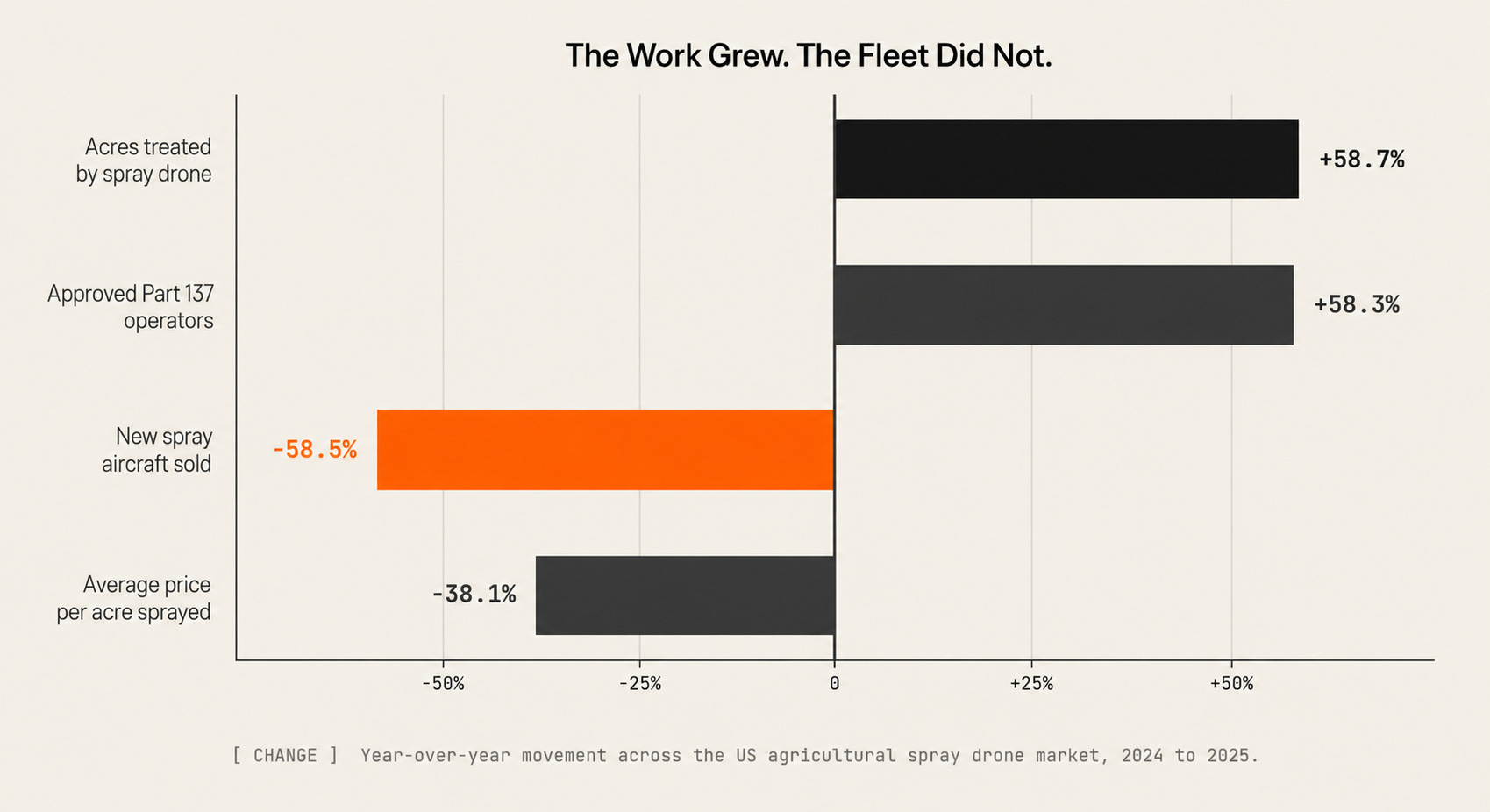
The work grew, the fleet did not, and the price fell while both happened. Source: American Spray Drone Coalition.
Where the Aircraft Went
New aircraft sales fell by almost exactly the proportion the acreage rose.
The survey compiles sales data from manufacturers and distributors rather than from a registry. It puts new spray drone sales at roughly 8,950 units in 2024 and roughly 3,711 in 2025.
The cause is not demand. From October 2024, US customs authorities halted processing of shipments from the category’s dominant manufacturer, and the survey names that stoppage as the primary drag on the whole market. Operators who wanted to expand capacity could not buy the aircraft to do it with.
What happened to the share those aircraft left behind is the part worth reading twice. Aircraft made in China fell from 93.52 percent of units sold to 75.75 percent. Aircraft made in the United States rose from 6.48 percent to 24.25 percent. The survey is direct about what that means. XAG and EAVision, both Chinese manufacturers, absorbed most of the gap, so the American gain came from a vacuum rather than from a switch.
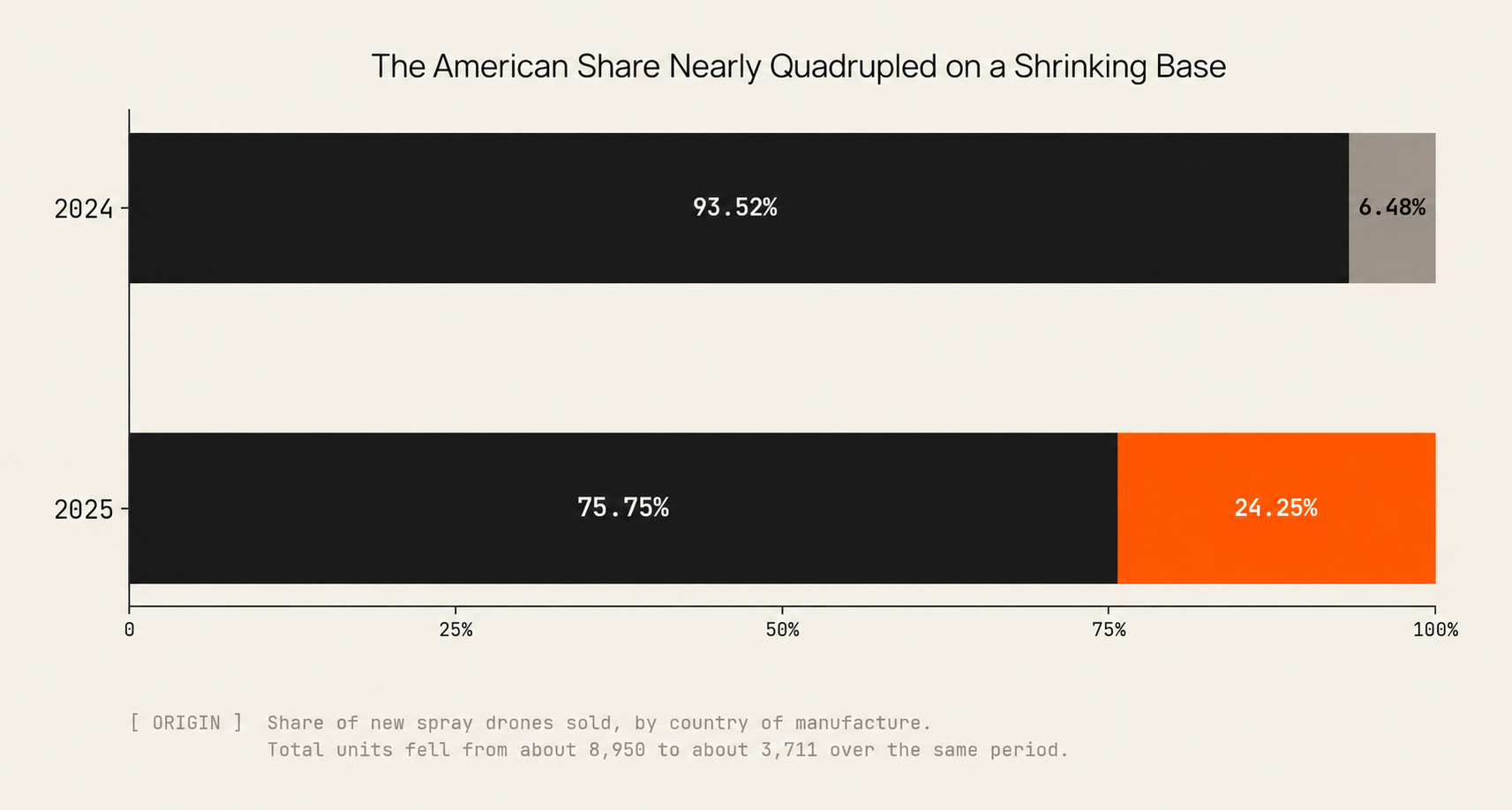
American share nearly quadrupled on a base that more than halved. Source: American Spray Drone Coalition.
An Acre Got Thirty-Eight Percent Cheaper
The price of the work fell while the supply of aircraft was constrained.
That combination is unusual enough to be a signal on its own. The average price per acre sprayed dropped from $21 to $13, a decline of 38 percent, in the same year the fleet shrank.
The survey’s explanation is a counting problem. Certificated operators report being undercut by operators flying without a Part 137 certificate, most sharply in the corn belt. The registration data supports the scale of that shadow market. The FAA’s own forecast recorded 1,243 large agricultural aircraft registered in 2024, against sales figures many times higher. That implies roughly 86 percent of spray drones sold sit outside the certified population.
A shrinking fleet and a falling price only coexist when the market being counted is not the market being flown. Every figure in this issue describes the certified quarter of an industry, and the other three quarters are setting the price.
What the Operator Is Actually Buying On
Country of origin ranks near the bottom of the purchase decision.
This is where the American opening gets conditional. . Asked what they would pay for an aircraft built in the United States, 49 percent of operators said they would refuse any premium at all. A further 41 percent would pay up to 25 percent more.
Asked what drives the choice of model, they ranked productivity and efficiency first, with features and software rated as important or better by 96 percent of respondents. Origin had very little influence.
The buyer is also small. Sixty-nine percent of certified operators run two aircraft or fewer, which means most purchase decisions are made by an owner-operator weighing a single airframe against a season of work.
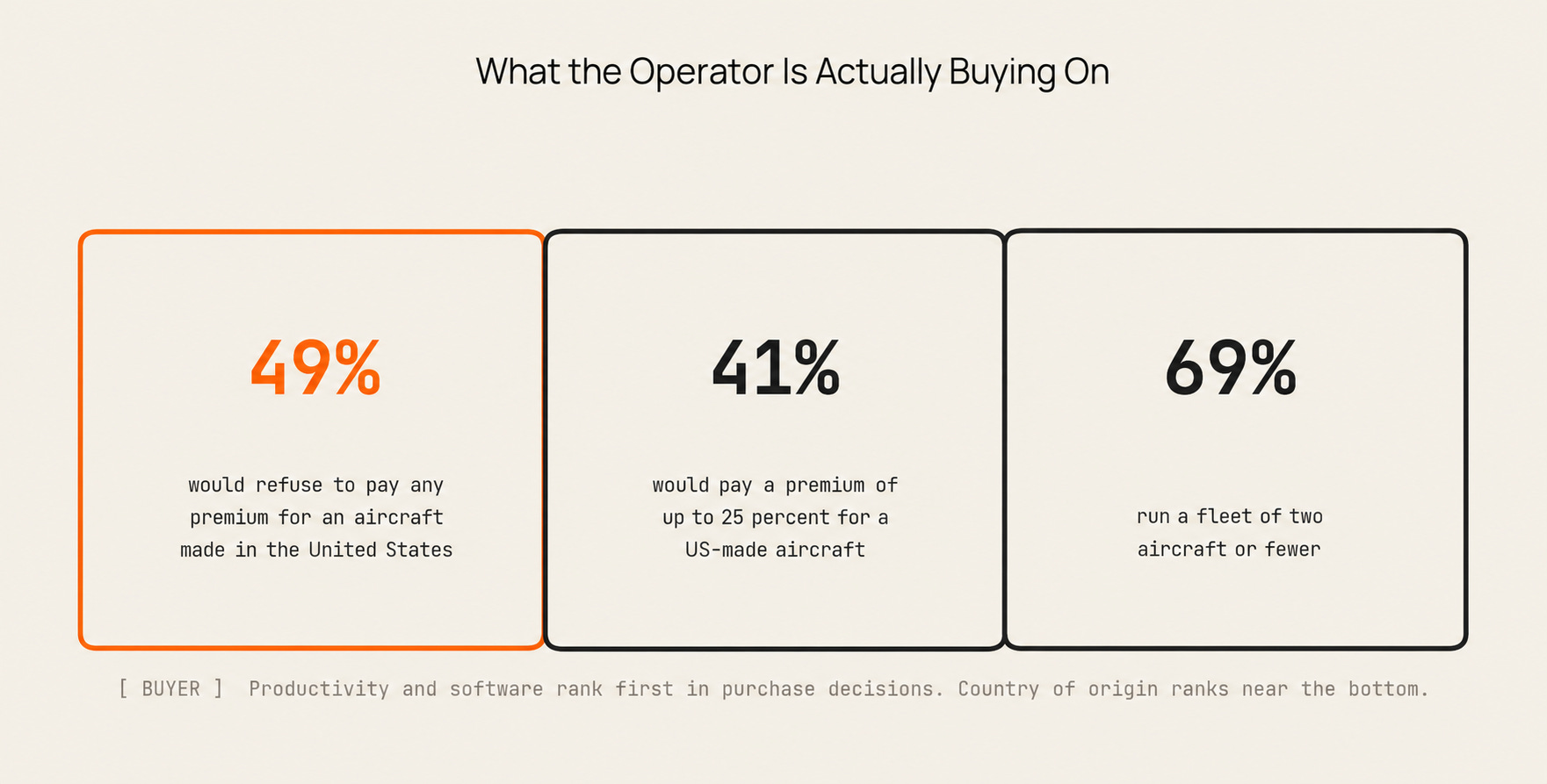
Productivity and software rank first in the purchase decision. Source: American Spray Drone Coalition.
A Heavy-Lift Airframe Enters the Category
On July 23 a US heavy-lift manufacturer set up an agriculture division and named its distributors.
Kaizen Aerospace, a Powerus company, announced a dedicated agriculture division alongside two agreements. Aerospread Technologies of Napier, New Zealand takes exclusive agency and distribution for the xFold platform across Australia, New Zealand and the South Pacific, against a five-year sales target of $60 million. The release states plainly that the figure is a performance objective and not a binding purchase commitment..
In the United States, Sprig Aerospace of Benton, Kentucky became an authorized distributor and will standardize its own commercial spraying fleet around the aircraft. Reporting by DRONELIFE records the certification step that came with it. The FAA issued Sprig a special airworthiness certificate in the experimental category, plus a certificate of waiver or authorization, covering research and development flying of the Dragon H1000.
The airframe family is described publicly as eight-rotor aircraft carrying between 100 and 1,000 pounds. Sprig’s cofounder Alex Scott called the result “the largest vertical-takeoff-and-landing crop duster drone in the industry,” which is a company statement of intent rather than an independently verified ranking.
Set against the survey, the entry is legible. An operator who will not pay a premium for origin will pay for acres per flight, and payload is the most direct route to that number.
The Category Is Growing Faster Than the Fleet
Forecasts for agricultural autonomy assume a fleet several times the size of the one being sold.
Grand View Research values the global agriculture drones market at $3.37 billion in 2025 and projects $21.59 billion by 2033, a compound annual growth rate of 26.5 percent. North America held the largest regional share at above 33.5 percent, and rotary wing platforms accounted for 61.7 percent of revenue.
Treat the precision with appropriate caution. Research houses publish materially different numbers for this category depending on where they draw its edges, and the useful part is the direction rather than the decimal.
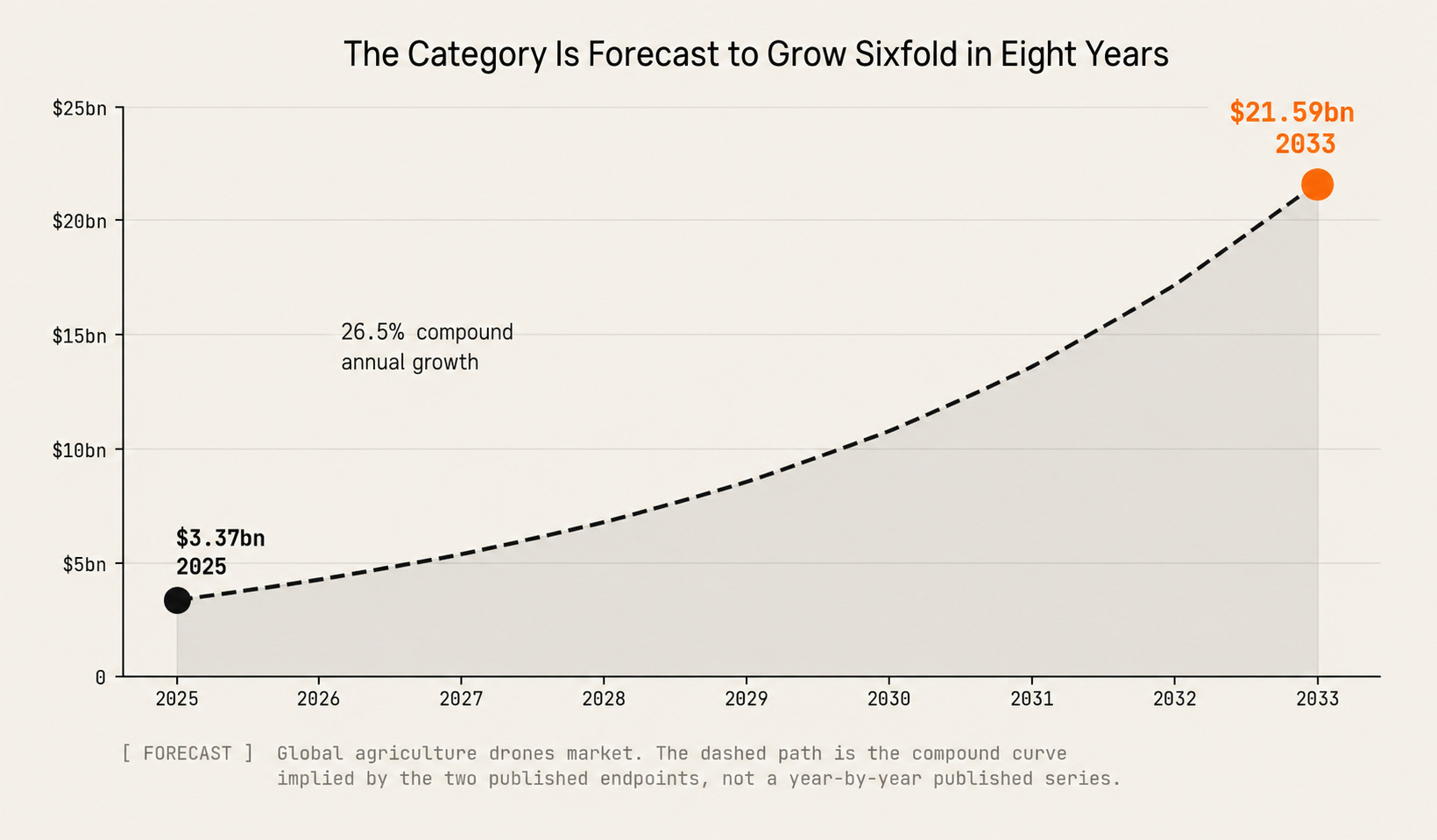
The path shown is the compound curve implied by the two published endpoints. Source: Grand View Research.
The Constraint Sits in the Battery
Per-operator output stayed flat while better airframes arrived, and the reason is the energy budget.
Acres per flight is a function of how much an aircraft can carry and how long it can stay up. Both are set by the cells. On July 24, Factorial Energy announced its first commercial aerospace order, supplying high energy density lithium metal cells to a US pack integrator serving a US drone manufacturer. Flight testing showed more than a 30 percent increase in range against conventional batteries, and design through integration took six months.
The order size and the customer were not disclosed. The number that matters is the 30 percent, because it is the first commercial figure attached to the constraint that kept 1,710 operators at 9,584 acres each.
Until the energy budget moves, a bigger airframe raises acres per flight more reliably than a better one does. That is an uncomfortable answer for software, and a straightforward one for anyone building payload.
What to Watch (July 27 to August 3)
The S-4 review. The registration statement has not yet become effective and remains subject to SEC review, comment, and amendment. Its effectiveness is among the customary closing conditions for the proposed combination.
Whether the certified operator count keeps climbing at this rate. The FAA’s Part 137 approval count is the cleanest available proxy for the professional side of the market, and it is the number the whole survey is scaled from.
Whether new aircraft supply recovers, and from where. The 2025 gap was filled mostly by other Chinese manufacturers. A second year of the same pattern tells you the American opening was temporary.
Whether $13 an acre holds. Price stabilization would suggest the uncertifiied side has found its floor. Another decline squeezes the operators the survey actually counts.
Whether any distribution agreement converts into delivered aircraft. Agency agreements and five-year targets are announcements. Deliveries are the measure.
Bottom Line: The Opening Has a Condition Attached
The headline number for American agricultural autonomy in 2025 is flattering. Domestic share of new spray aircraft nearly quadrupled, acreage set a record, and the operator base grew by more than half.
The mechanism behind it is not. The share moved because the dominant supplier could not ship, and most of the freed volume went to two other manufacturers from the same country rather than to American builders. The acreage grew because more people entered, not because the aircraft improved. And the price of the work fell 38 percent while all of it was happening.
That leaves a market with a genuine opening and a clear condition on it. Half the buyers will not pay anything extra for where an aircraft was built, and they rank productivity first by a wide margin. Whoever wants the share that came free in 2025 has to earn it again in 2026 on acres per flight and cost per acre. Distribution agreements and airworthiness certificates are how a manufacturer gets to the starting line. Delivered payload is how it stays.
If you fly a spray operation: what would actually make you pay more for an aircraft, and how much more? Put a number on it in the comments.
About the proposed transaction
Powerus previously announced a proposed merger with Aureus Greenway Holdings Inc. (Nasdaq: PUSA); the merger has not closed and remains subject to the satisfaction of customary closing conditions, including the effectiveness of a registration statement on Form S-4 and applicable regulatory approvals.
No Offer or Solicitation: This publication is for informational purposes only and is not intended to and shall not constitute an offer to buy or sell or the solicitation of an offer to buy or sell any securities, or a solicitation of any vote or approval, nor shall there be any sale of securities in any jurisdiction in which such offer, solicitation or sale would be unlawful prior to registration or qualification under the securities laws of any such jurisdiction. No offering of securities shall be made, except by means of a prospectus meeting the requirements of Section 10 of the U.S. Securities Act of 1933, as amended.
Forward-Looking Statements: Statements in this issue regarding the proposed merger between Powerus and AGH, the filing of the registration statement on Form S-4 and its declaration of effectiveness by the SEC, the expected timing of the completion of the merger, and the anticipated listing and trading of the combined company’s securities are forward-looking statements within the meaning of the Private Securities Litigation Reform Act of 1995. These statements are based on current expectations and assumptions and are subject to risks and uncertainties that could cause actual results to differ materially. See the company’s announcement for the full discussion of those risks. Forward-looking statements speak only as of the date of this publication, and except as required by law, neither company undertakes any obligation to update them.
Important Information and Where to Find It: In connection with the transaction, AGH has filed a registration statement on Form S-4 with the SEC, which includes an information statement and preliminary prospectus of AGH. Investors and security holders are urged to read the registration statement and information statement/prospectus when they become available, and any other documents filed with the SEC in connection with the transaction, because they will contain important information regarding the proposed transaction and related matters. Investors and security holders may obtain free copies of these documents through the website maintained by the SEC at www.sec.gov or at AGH’s website.
Powerus builds autonomous systems for defense, counter-UAS, agriculture, wildfire response, and maritime operations. Designed, manufactured, and assembled in the United States.