
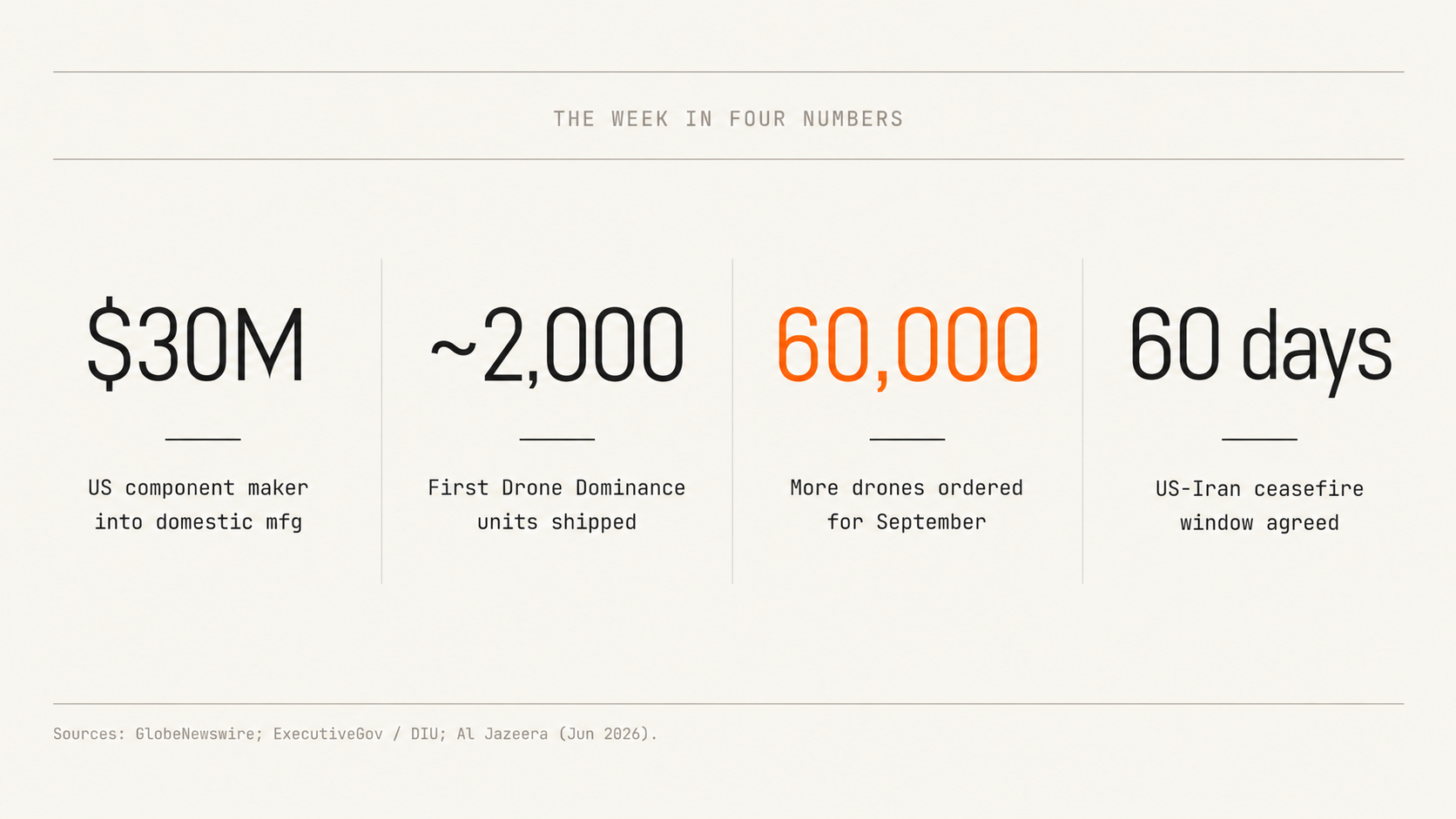
The Week the Supply Chain Came Home
Parts get financed, the first program units ship, and a fragile truce gets signed.
Powerus Signal · Week of June 22, 2026

Sources: $30M strategic investment (GlobeNewswire, June 16, 2026); first units shipped (ExecutiveGov / DIU); 60,000 ordered for September (DoD News); 60-day ceasefire window (Al Jazeera).
The last edition tracked the surge becoming permanent structure. This edition tracks that structure becoming physical. The buildout stopped being budget lines and policy this period and started being delivered parts, accepted hardware, and a component base financed to sit inside US borders.
The earlier editions followed the demand signal up the chain: live wars, then orders, then a four-star command built to keep buying. This period the chain runs the other way, from policy down into product. The first hardware under the Pentagon's flagship drone program was accepted and shipped, a US parts maker put capital into a domestic manufacturer days before a ban on Chinese components takes hold, and the truce that was announced earlier got formalized on paper.
The through-line is that sourcing is now the contest. A buyer that persists across budget cycles still has to be fed by factories that can produce at volume, pass acceptance, and prove where every motor and flight controller came from. The events of this period all point at the same pressure: the parts, the units, and the rule that governs both are converging on domestic ground.
This briefing covers the hardware that moved, the parts base that got financed, the qualifier that raises the manufacturing bar, and the two wars that keep setting the terms the buildout answers to.
Hardware Comes Off the Line
The Pentagon's flagship drone program crossed from ordered to accepted, with the first units shipped and a far larger order lined up for the fall.
On June 18 the Defense Innovation Unit confirmed the Department of War accepted its first batch of unmanned aircraft under the Drone Dominance program and shipped roughly 2,000 units to the services. Phase I has already purchased 30,000 drones, now being delivered, with an order for 60,000 more slated for September. The program is a two-year, roughly $1.1 billion effort built to scale from 30,000 toward 150,000 units per phase, drive unit cost down from about $5,000 toward $3,000, and reach more than 200,000 AI-enabled drones by 2027.

A roughly $1.1 billion, two-year US-made buy. Sources: ExecutiveGov; Defense Innovation Unit (June 2026).
Acceptance is the moment a program stops being a budget line and becomes a customer. A purchase order can be cut in a markup. A unit that has been built, accepted, and shipped to a service is a transaction that already cleared. The program is the federal government's clearest signal that it intends to buy low-cost, US-manufactured drones at a scale the prior vendor base was never built to fill.
The ramp also resets the math on who can compete. Driving unit cost toward $3,000 while pushing annual volume past 200,000 is a manufacturing problem before it is a technology problem. The advantage moves to whoever can hold cost and quality at that volume, on a domestic line.
The Parts Base Goes Domestic
A US component maker financed a domestic drone manufacturer days before a ban on Chinese suppliers takes effect, hardening an all-American parts base.
The standout corporate move of the period was a $30 million strategic investment by Unusual Machines, a US, NDAA-compliant maker of drone components such as motors and flight controllers, into Powerus on June 16. The investment deepens an existing supply relationship between the two companies, with the stated aim of scaling domestic autonomous-drone manufacturing. It is one example of capital wiring an American parts base into place at the exact moment the procurement rules turn against foreign-made hardware.
The timing is the point. On June 8 the Pentagon designated 188 Chinese companies as military entities, including Alibaba, Baidu, and BYD. Under Section 805 of the fiscal 2024 defense authorization, a direct-contracting ban on the listed firms takes effect June 30, and the list grew from 134 entities to 188 in this update. A second tier covering indirect procurement through supply chains follows in mid-2027.
 Foreign-component sourcing moves from a preference to a procurement rule. Sources: NPR; The Hill (June 2026), citing Section 805 of the FY2024 NDAA.
For domestic manufacturers, the two events are one story. The rule narrows the field to suppliers who can prove a clean parts trail, and the capital follows the rule. Where a buyer might once have weighed the cheapest component, the default now favors a part that clears the procurement filter, and the money is moving to build that capability at home before the deadline lands.
Two forces met in the same period. A ban that defines who is allowed to supply the hardware, and capital that finances the suppliers who qualify. Together they make domestic sourcing the price of entry, not a selling point.
Gauntlet II Raises the Bar
The next qualifier round adds night and urban operations and demands more drones per entrant, lifting the manufacturing threshold again.
The Defense Innovation Unit also announced Gauntlet II, the next qualifier round set to begin later this summer. It raises the bar by adding night operations and urban, confined environments, and it requires each entrant to bring 120 drones to qualify. The Phase II qualifier at Camp Grayling drew 49 companies fielding 79 unique unmanned systems.
The 120-drone entry requirement is the quiet filter. A company that can hand-build a winning prototype is not the same as a company that can put 120 qualified units on a range, and the gap between the two is exactly the manufacturing capacity the program is trying to surface. Each round of the gauntlet screens harder for the vendors who can produce at scale rather than demonstrate at one.
That is consistent with the period's larger pattern. The policy builds the buyer, the ban defines the supply pool, and the qualifier keeps raising the production bar that decides who stays in it.
One War Signs, Then Wobbles
A framework deal formalized the Gulf ceasefire on paper, but a re-closure of the Strait of Hormuz showed how fragile it remains.
The geopolitical headline of the period was the formalization of the US-Iran agreement. After the deal was announced in mid-June, a 14-point memorandum of understanding setting a framework for a 60-day negotiation was signed, with a ceremony at Bürgenstock, Switzerland on June 19. The framework covers a lift of the naval blockade, a transit window through the Strait of Hormuz, and a path toward a final nuclear deal, with a proposed $300 billion investment fund that remains conditional on a final agreement and has drawn its own dispute.
The arrangement is a framework, not a settlement, and it showed its seams within days. On June 20, Iran declared the Strait of Hormuz closed over what it called ceasefire violations tied to Israeli strikes in Lebanon, a closure US Central Command disputed, saying 55 merchant ships transited the waterway that day moving more than 17 million barrels of oil. The read for the buildout is the same as the prior period, only sharper. A signed ceasefire trims the near-term Gulf threat that has justified much of the counter-drone urgency, but the war has proved the exact problem the buildout targets, cheap drones overwhelming expensive defenses, and a truce that can wobble in 48 hours does not retire that problem.
A signature on paper can cool a threat. It cannot un-teach a lesson. The demand for affordable interception was built by the fighting, not by the ceasefire, and it outlasts a deal that strains within days of being signed.
The Other War Keeps Writing the Rules
Deep strikes on a Moscow refinery and the Crimean Bridge keep turning energy and logistics into the front line.
The eastern front showed no such pause. On June 18, Ukraine struck the Kapotnya oil refinery in Moscow, roughly 16 km from the Kremlin, in what was described as its largest attack on the Russian capital in years, with Russia claiming its defenses downed several hundred drones. On June 21, Ukrainian forces hit both sides of the Crimean Bridge along with oil-transport logistics in the Krasnodar region and an oil depot at Kerch, prompting authorities in occupied Crimea to suspend civilian fuel sales. President Zelensky warned of a new large-scale Russian strike in response.
 Long-range one-way drones turn energy and logistics infrastructure into the front line. Sources: NBC News; Kyiv Independent; RFE/RL (June 2026). Reach is approximate.
The lesson across both theaters is the one every prior edition has drawn. Mass-produced one-way drones and affordable interception are the center of gravity of modern conflict. The Middle East may be cooling on paper, but the war in the east keeps writing the doctrine in real time, reaching hundreds of kilometers to put refineries, bridges, and fuel depots inside the fight. The truce does not change the lesson; it only changes which front is teaching it this period.
Where the Dollars Compound
Federal dollars keep concentrating in the fastest-compounding corner of the market, not the aggregate.
The hardware and the capital land on a counter-drone market that remains the industry's fastest-growing niche. MarketsandMarkets projects the counter-UAS market growing from roughly $6.6 billion in 2025 to $20.3 billion by 2030, near a 25 percent compound annual growth rate, with the United States holding the largest share. The broader drone market sits on a wider $69 billion to $148 billion trajectory through 2036, per IDTechEx.
 The fastest-compounding corner of the market, and where this period's federal dollars are pointed. Source: MarketsandMarkets, counter-UAS market outlook (2025 to 2030).
The aggregate number is not where the action is. The federal dollars concentrate in counter-UAS, autonomy software, and the production capacity to field cheap mass at home. The market forecast and the new procurement rules point the same direction, toward domestic scale in the corner that compounds fastest. The directed-energy side reinforces it: the Pentagon is fielding high-energy laser and microwave systems at five US bases by year-end, a sign that counter-drone demand is spreading from the battlefield to the homeland.
What to Watch (June 22 to 29)
Four near-term events. Each tests how fast the new structure can field what it is built to buy.
The contracting ban takes effect June 30. The bar on direct contracts with the 188 listed Chinese firms becomes active, the first hard test of how the rule reshapes supplier choices across the drone industrial base.
Iran ceasefire durability and the Bürgenstock talks. The 60-day technical negotiations on the nuclear file, Hormuz transit, and sanctions continue in Switzerland. After the June 20 Hormuz re-closure, the ceasefire's durability is the single biggest swing factor for defense-sector sentiment.
The NDAA conference path. With the Senate's roughly $1.14 trillion bill reported out and the House version advancing toward floor consideration expected the week of June 29, watch for the start of reconciling the two before the August recess.
Gauntlet II kickoff and the September order. Watch for the formal start of Gauntlet II, with its night and urban requirements at 120 drones per entrant, and any detail on the 60,000-unit September buy. Both set the bar for which US manufacturers scale into the next phase.
Each is measurable and near-term, and none depends on a single company. Together they describe how fast the United States can turn a domestic supply base into fielded capability.
Bottom Line: The Surge Got a Supply Chain
The story moved from what is ordered to what is sourced. Where the parts come from, and who can build them at home, is now the contest.
This was the period the drone buildout grew a supply chain. The Pentagon accepted and shipped its first Drone Dominance units and lined up 60,000 more for the fall, a US component maker financed a domestic manufacturer days before the June 30 ban on 188 Chinese suppliers, and Gauntlet II raised the production bar again. The war on Iran moved to a signed framework that wobbled inside a week, and that fragility changes nothing about the lesson both wars keep teaching: cheap mass on offense, affordable interception on defense.
The constraint is the one a purchase order cannot solve on its own. A buyer can be built and a contract can be signed, but the units still have to be manufactured, accepted, and sourced from parts that clear the rule, on a fixed timeline. The winners for the rest of the decade will be whoever can do all of that at scale, on an all-American line. The structure is now being built to buy from them. The open question is who can supply it.
The buyer is built, the orders are landing, and a foreign-component ban is days away. With a domestic parts base now being financed into place, which is the binding constraint on fielding at scale: capital, components, or acceptance throughput? Reply with your read.
Powerus builds autonomous systems for defense, counter-UAS, agriculture, wildfire response, and maritime operations. Designed, manufactured, and assembled in the United States.